Home / Artworks / Table Fountain
Table Fountain
Unknown maker (France), c. 1320–40
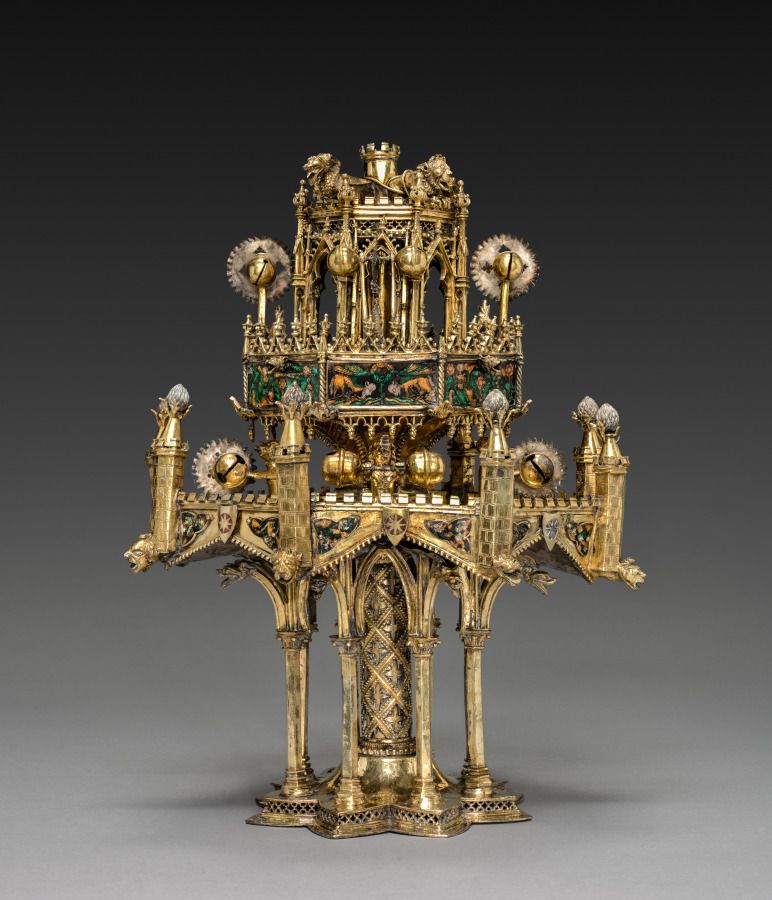
This object, made in Paris around 1320 to 1340, is a Gothic building in miniature, with vaults, pinnacles, columns and traceried arches. The Cleveland Museum of Art says its unknown maker was clearly inspired by the great Gothic churches of his time.
It has three tiers, made of cast parts and bent sheets of gilt silver. Enamel plaques show grotesque figures, some of them playing musical instruments. Water wheels and bells were added to catch movement and sound.
The materials and the detail suggest it was costly, treasured and meant to be a spectacle for a high-status owner. The museum says it is the most complete example of its type known to survive from the Middle Ages. Medieval inventories show that small fountains in precious metal once existed in large numbers. It stands about 34 centimetres high.
From the museum record
| Artist | Unknown maker (France) |
|---|---|
| Date | c. 1320–40 |
| Medium | Gilt-silver and translucent enamels |
| Size | Overall: 33.8 x 25.4 x 26 cm |
| Museum | The Cleveland Museum of Art |
| Credit line | Gift of J. H. Wade |
| Accession number | 1924.859 |
| Licence | Open Access (CC0) |
Source: The Cleveland Museum of Art collection record. Facts such as dates, sizes and credit lines come from that record. The write-up above was drafted with AI assistance and checked against the museum record and standard references. Spotted a mistake? Tell us.