Home / Artworks / Terpsichore Lyran (Muse of Lyric Poetry)
Terpsichore Lyran (Muse of Lyric Poetry)
Antonio Canova, 1816
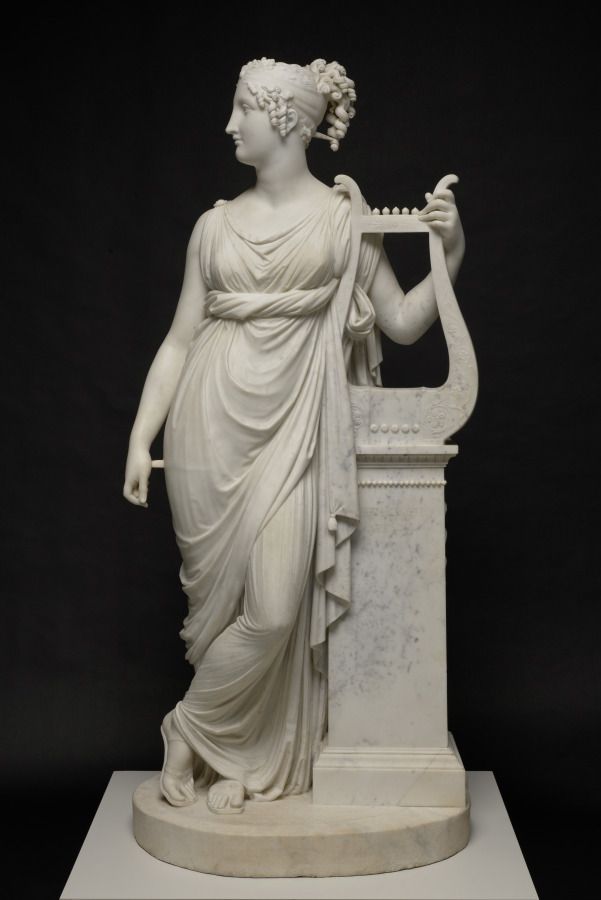
Terpsichore was one of the nine Muses in Greek mythology, the goddesses of creative inspiration. The lyre, the Greek inscription on the short column and the entwined snakes of the caduceus on its side identify this figure as Terpsichore Lyran, the muse of lyric poetry.
The sculpture started with a commission from Napoleon's brother Lucien, who wanted an idealised portrait of his wife, Alexandrine. Antonio Canova made this version for a British aristocrat. He showed it in 1817 at the Royal Academy in London, where it was widely praised.
The marble is about 1.8 metres tall. Canova was known for the soft, almost skin-like finish of his surfaces, which he achieved with very fine polishing. Look at how the thin drapery clings to the body.
From the museum record
| Artist | Antonio Canova |
|---|---|
| Date | 1816 |
| Medium | Marble |
| Size | Overall: 177.5 x 78.1 x 61 cm |
| Museum | The Cleveland Museum of Art |
| Credit line | Leonard C. Hanna Jr. Fund |
| Accession number | 1968.212 |
| Licence | Open Access (CC0) |
Source: The Cleveland Museum of Art collection record. Facts such as dates, sizes and credit lines come from that record. The write-up above was drafted with AI assistance and checked against the museum record and standard references. Spotted a mistake? Tell us.