Home / Artworks / White-Ground Lekythos (Oil Vessel): Atalanta and Erotes
White-Ground Lekythos (Oil Vessel): Atalanta and Erotes
Douris, c. 500–490 BCE
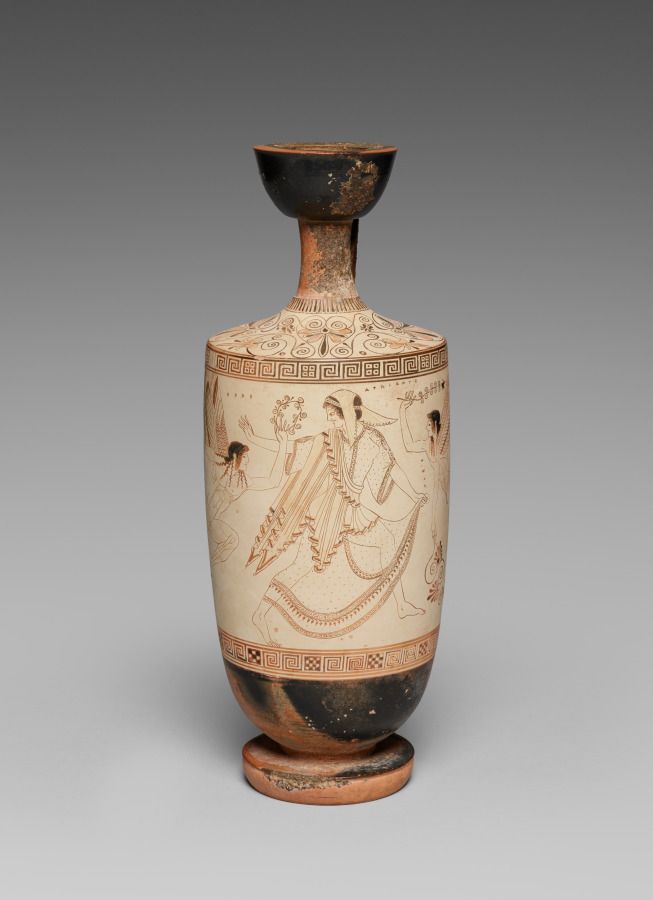
A lekythos is a Greek vessel for oil. This one is called white-ground because it was coated with a white clay slip as a surface for painting. The Cleveland Museum of Art says that vases of this type give some idea of the lost large-scale wall paintings of the ancient world.
The picture wraps all the way around the vase. At the centre Atalanta, the virgin huntress known for her speed and for her opposition to marriage, runs to the right and looks back at Eros, the winged god of love. Both are named in the picture. Eros bounds forward, trying to crown her, while two more Erotes, also named, hem her in. As the museum puts it, love will win.
The vase is attributed to Douris and dates to around 500 to 490 BCE. It is about 32 centimetres tall and is remarkably well preserved.
From the museum record
| Artist | Douris |
|---|---|
| Date | c. 500–490 BCE |
| Medium | Ceramic |
| Size | Overall: 31.8 cm |
| Museum | The Cleveland Museum of Art |
| Credit line | Leonard C. Hanna Jr. Fund |
| Accession number | 1966.114 |
| Licence | Open Access (CC0) |
Source: The Cleveland Museum of Art collection record. Facts such as dates, sizes and credit lines come from that record. The write-up above was drafted with AI assistance and checked against the museum record and standard references. Spotted a mistake? Tell us.