Home / Artworks / Talatat: Portrait of Nefertiti
Talatat: Portrait of Nefertiti
Unknown maker (Egypt), c. 1353–1347 BCE
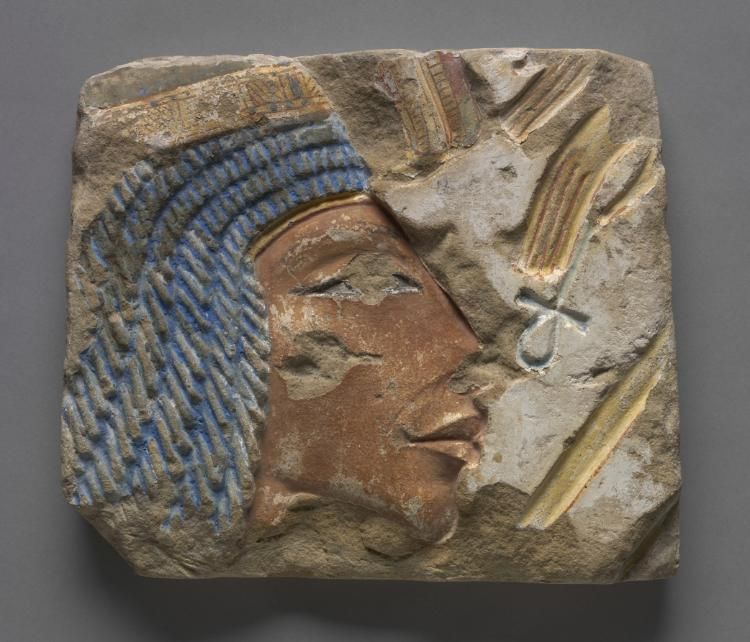
A talatat is a small standard-sized sandstone block used in building. This one, made around 1353 to 1347 BCE, comes from Karnak and shows the portrait of Queen Nefertiti.
The Cleveland Museum of Art explains that Akhenaten, son of Amenhotep III, began a short-lived revolution in Egyptian religion in the late 18th Dynasty. He built a temple complex to the Aten, the sun disk, at Karnak before he moved his capital to Amarna. For reasons not yet known, Nefertiti appears in these reliefs far more often than the king does.
The Aten temples were taken apart in ancient times and the blocks used as foundation and fill for additions to the Great Temple of Amun, whom the Aten had briefly displaced. That reuse is why the blocks survive. This one is about 21 by 24 centimetres.
From the museum record
| Artist | Unknown maker (Egypt) |
|---|---|
| Date | c. 1353–1347 BCE |
| Medium | Painted sandstone |
| Size | Overall: 21.5 x 24.3 cm |
| Museum | The Cleveland Museum of Art |
| Credit line | Purchase from the J. H. Wade Fund |
| Accession number | 1976.4 |
| Licence | Open Access (CC0) |
Source: The Cleveland Museum of Art collection record. Facts such as dates, sizes and credit lines come from that record. The write-up above was drafted with AI assistance and checked against the museum record and standard references. Spotted a mistake? Tell us.