Home / Artworks / Fire-flame Cooking Vessel (Ka'en Doki)
Fire-flame Cooking Vessel (Ka'en Doki)
Unknown maker (Japan), c. 2500 BCE
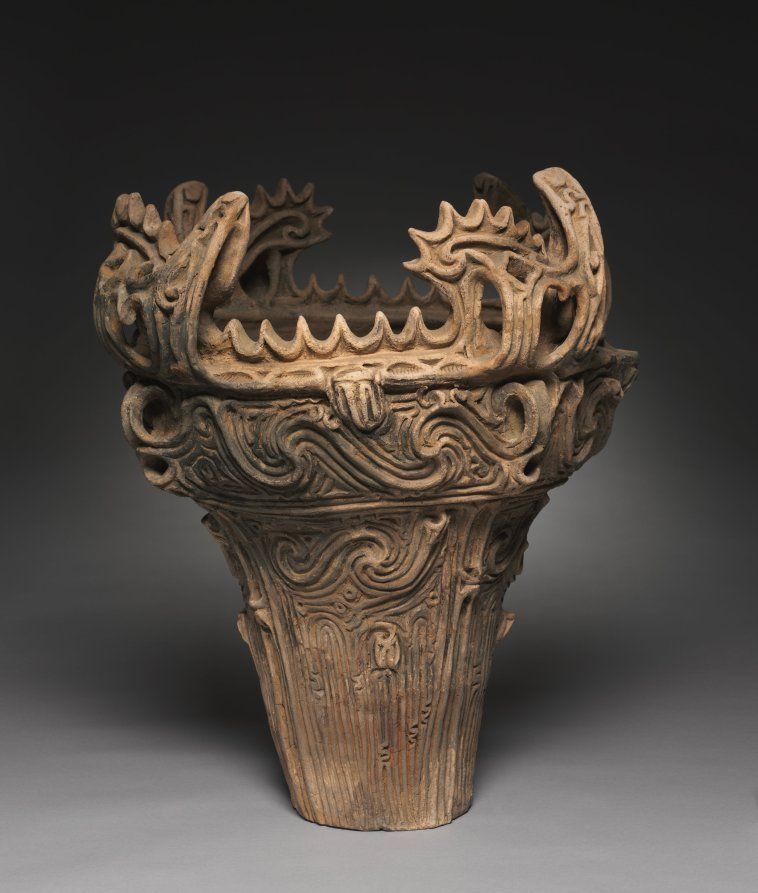
Archaeologists call this type of vessel fire flame, or ka'en in Japanese, because its rim looks like flames. The Cleveland Museum of Art says nobody knows why this design was made or what it stands for. It dates to about 2500 BCE, in the Jōmon period of Japan.
It is unusual for how much of it is original. The museum says it was recently found that a base from a different vessel was used when the pot was rebuilt in the 1900s, which gave a false idea of its size. It would originally have been about four inches shorter. Vessels like this were set into holes in the ground when used, so the lower parts often deteriorate or go missing.
The pot is about 61 centimetres high and 56 centimetres across, earthenware with carved and applied decoration.
From the museum record
| Artist | Unknown maker (Japan) |
|---|---|
| Date | c. 2500 BCE |
| Medium | Earthenware with carved and applied decoration |
| Size | Height: 61 cm |
| Museum | The Cleveland Museum of Art |
| Credit line | John L. Severance Fund |
| Accession number | 1984.68 |
| Licence | Open Access (CC0) |
Source: The Cleveland Museum of Art collection record. Facts such as dates, sizes and credit lines come from that record. The write-up above was drafted with AI assistance and checked against the museum record and standard references. Spotted a mistake? Tell us.