Home / Artworks / Haniwa Horse
Haniwa Horse
Unknown maker (Japan), 400s–500s CE
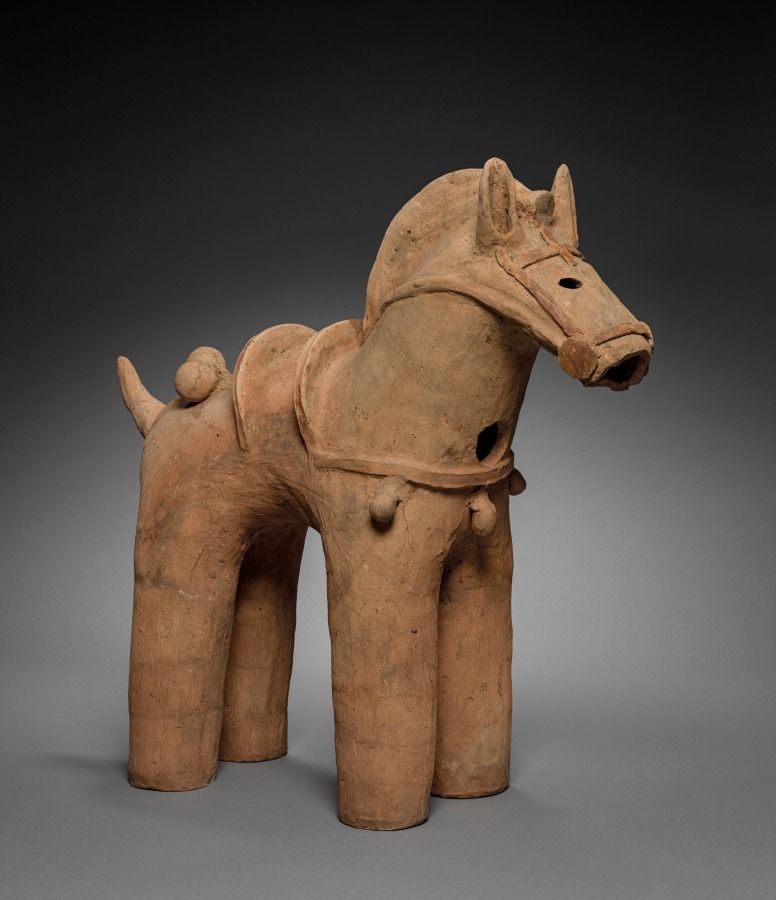
This horse comes from the Kofun period of Japan, which runs from 300 to 710 CE. According to the Cleveland Museum of Art, its harness, with round bells, looks like saddlery that was fashionable in Korea in the 400s and 500s. At the same time as a mass migration from the Korean Peninsula, tombs covered with large earth mounds, like those on the Asian continent, began to appear in Japan around 300 CE.
These mounds are called kofun, meaning old mounds. Their surfaces were covered with hollow clay cylinders called haniwa. Sculptures of animals, buildings and finally human figures developed over the next three centuries.
The horse is earthenware with traces of pigment and is about 60 centimetres high.
From the museum record
| Artist | Unknown maker (Japan) |
|---|---|
| Date | 400s–500s CE |
| Medium | Earthenware with traces of pigment |
| Size | Overall: 59.7 x 66 cm |
| Museum | The Cleveland Museum of Art |
| Credit line | The Norweb Collection |
| Accession number | 1957.27 |
| Licence | Open Access (CC0) |
Source: The Cleveland Museum of Art collection record. Facts such as dates, sizes and credit lines come from that record. The write-up above was drafted with AI assistance and checked against the museum record and standard references. Spotted a mistake? Tell us.