Home / Artworks / Stacks of Wheat (End of Summer)
Stacks of Wheat (End of Summer)
Claude Monet, 1890–91
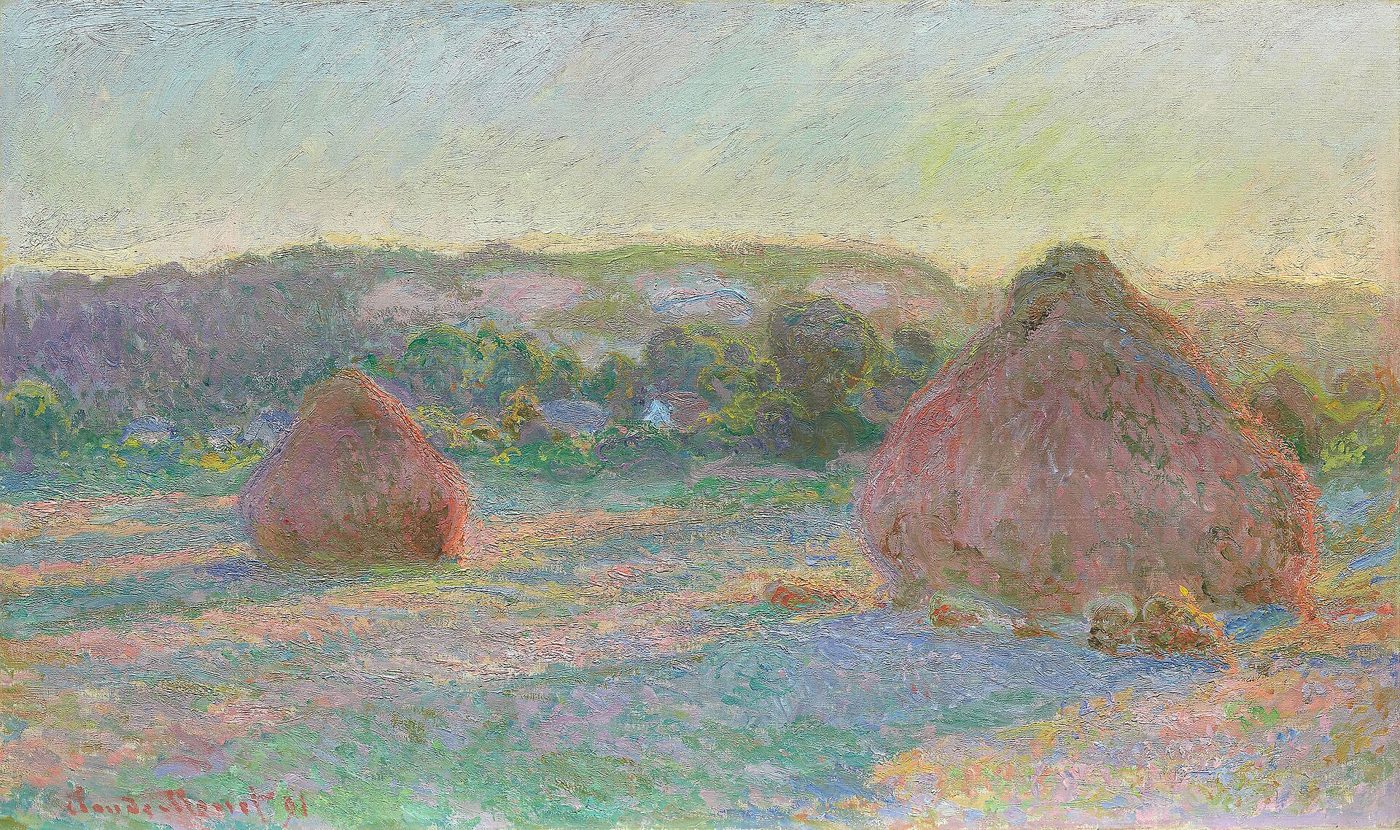
In 1890 and 1891 Claude Monet painted a series of grain stacks standing just outside his farmhouse at Giverny. According to the Art Institute of Chicago, the stacks were fifteen to twenty feet high. He worked on the series in the field, with several easels going at once, and finished the canvases in the studio.
In May 1891 he hung fifteen of them together in one small room at the Galerie Durand-Ruel in Paris. The show was a critical and financial success, and the museum describes it as a breakthrough both for Monet and for French art. This painting shows the end of summer. The conical tops of the stacks rise above the horizon and push into the sky, while in many winter views the stacks look tucked into the hills.
The Art Institute says that for Monet the stack was a symbol of sustenance and survival. He followed this series with poplars, then Rouen Cathedral, then his own garden. The museum holds the largest group of Monet's Stacks of Wheat in the world. This canvas is 60 by 100 centimetres.
From the museum record
| Artist | Claude Monet |
|---|---|
| Date | 1890–91 |
| Medium | Oil on canvas |
| Size | 60 × 100.5 cm (23 5/8 × 39 9/16 in.) |
| Museum | The Art Institute of Chicago |
| Credit line | Gift of Arthur M. Wood, Sr. in memory of Pauline Palmer Wood |
| Accession number | 1985.1103 |
| Licence | Public domain (CC0) |
Source: The Art Institute of Chicago collection record. Facts such as dates, sizes and credit lines come from that record. The write-up above was drafted with AI assistance and checked against the museum record and standard references. Spotted a mistake? Tell us.