Home / Artworks / The Crucifixion of Saint Andrew
The Crucifixion of Saint Andrew
Caravaggio, 1606–7
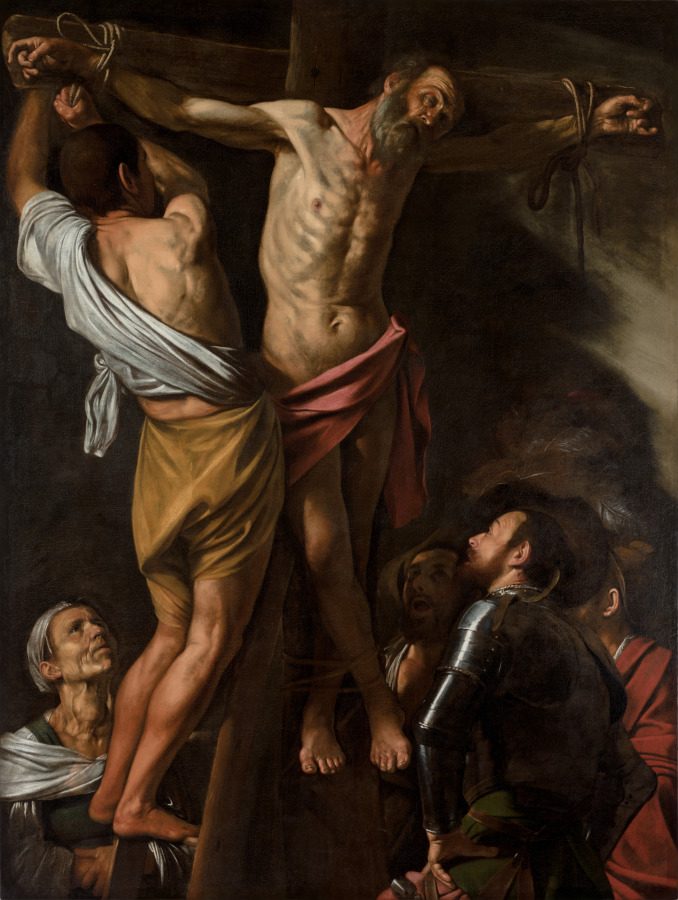
Caravaggio painted this around 1606 to 1607. According to the Cleveland Museum of Art, Saint Andrew was sentenced to die on the cross in Greece because he refused to deny his faith. He preached from the cross for two days to a growing crowd. When the authorities tried to release him, their hands were mysteriously paralysed, and Andrew died surrounded by divine light.
Caravaggio's version avoids a grand public scene. The viewer is brought in close, and the event feels intimate and private. Strong contrasts of light and dark suggest the presence of God. The Cleveland Museum calls it a masterpiece of Baroque painting and notes that it is the only altarpiece by the artist in America.
The canvas is about 2 metres high, 202.5 by 152.7 centimetres without its frame. The figures are crowded together at the front of the picture and the background falls away into darkness, which is typical of the way Caravaggio used light.
From the museum record
| Artist | Caravaggio |
|---|---|
| Date | 1606–7 |
| Medium | Oil on canvas |
| Size | Unframed: 202.5 x 152.7 cm |
| Museum | The Cleveland Museum of Art |
| Credit line | Leonard C. Hanna Jr. Fund |
| Accession number | 1976.2 |
| Licence | Open Access (CC0) |
Source: The Cleveland Museum of Art collection record. Facts such as dates, sizes and credit lines come from that record. The write-up above was drafted with AI assistance and checked against the museum record and standard references. Spotted a mistake? Tell us.