Home / Artworks / Aristotle with a Bust of Homer
Aristotle with a Bust of Homer
Rembrandt (Rembrandt van Rijn), 1653
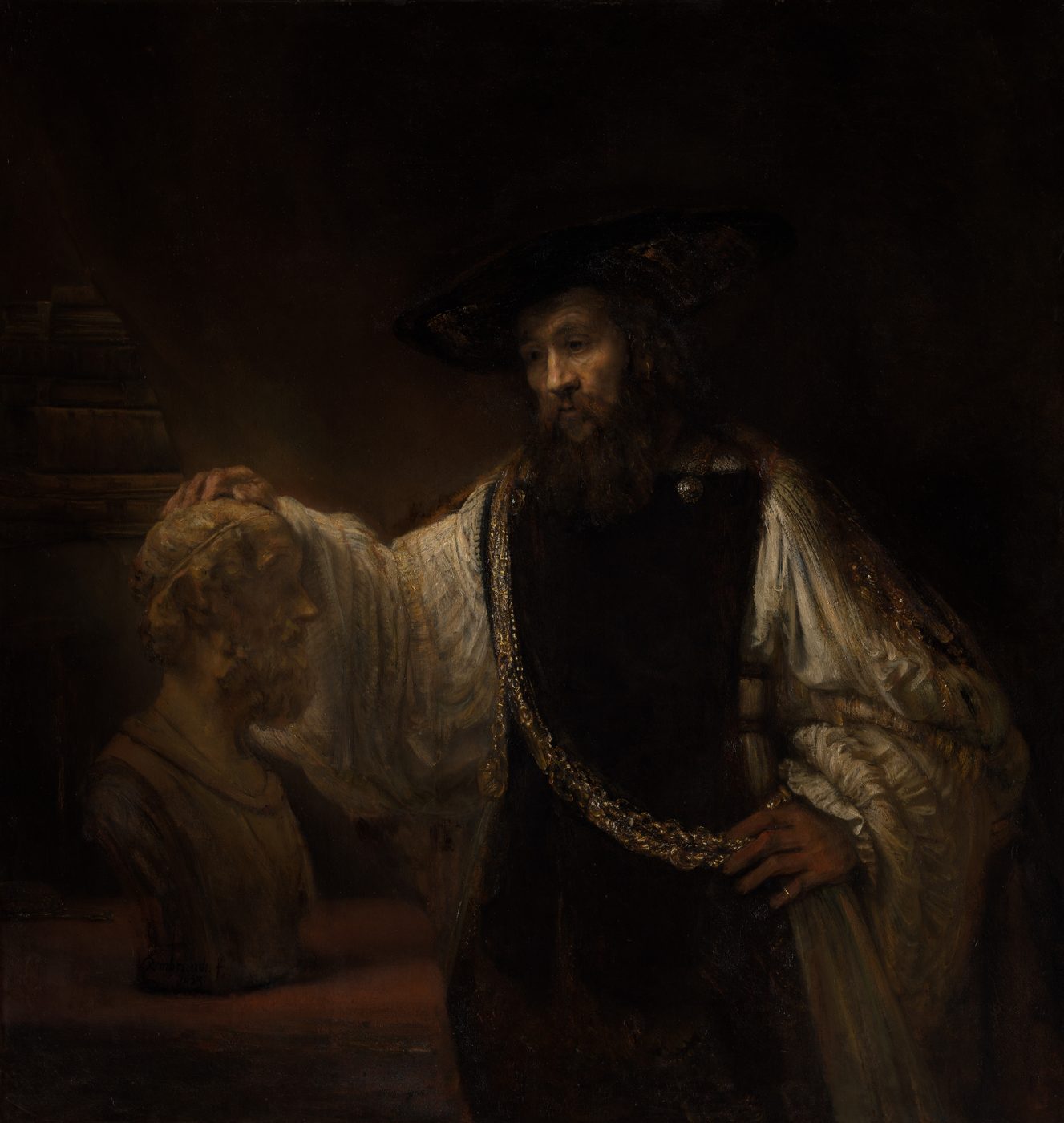
Rembrandt painted this in 1653 for Don Antonio Ruffo, a nobleman in Sicily. Ruffo did not ask for a specific subject. Rembrandt chose Aristotle, wearing a gold chain and a rich costume, resting his hand on a bust of the poet Homer.
The picture has no obvious action, and that is why people keep discussing it. Aristotle looks at the bust, not at us, and his expression is hard to read. Some viewers see a thinker weighing wisdom against fame or money, since the chain is a sign of wealth. Others see a respectful conversation between a philosopher and a poet. The museum record does not choose between these, and neither will we.
The painting is oil on canvas, 143.5 by 136.5 centimetres. The dark background lets the light fall on the face, the white sleeve and the gold chain. Rembrandt builds the chain from thick, quick dabs of yellow paint that look like jewellery from a few steps back. The painting was bought by the Metropolitan Museum in 1961.
From the museum record
| Artist | Rembrandt (Rembrandt van Rijn) |
|---|---|
| Date | 1653 |
| Medium | Oil on canvas |
| Size | 56 1/2 x 53 3/4 in. (143.5 x 136.5 cm) |
| Museum | The Metropolitan Museum of Art |
| Credit line | Purchase, special contributions and funds given or bequeathed by friends of the Museum, 1961 |
| Accession number | 61.198 |
| Licence | Open Access (CC0) |
Source: The Metropolitan Museum of Art collection record. Facts such as dates, sizes and credit lines come from that record. The write-up above was drafted with AI assistance and checked against the museum record and standard references. Spotted a mistake? Tell us.